Geestelijke verzorging
In this expression, geestelijke refers to the inner life and verzorging names the care provided.[1] The professional association describes it as support and advice about meaning and worldview.[1]
Country portrait · Europe
Geestelijke verzorging
In Amsterdam, Hospice Kuria includes a spiritual caregiver in its team.[9] In Utrecht, friends can remember someone together at the Rouwen en Vieren greenhouse.[3]
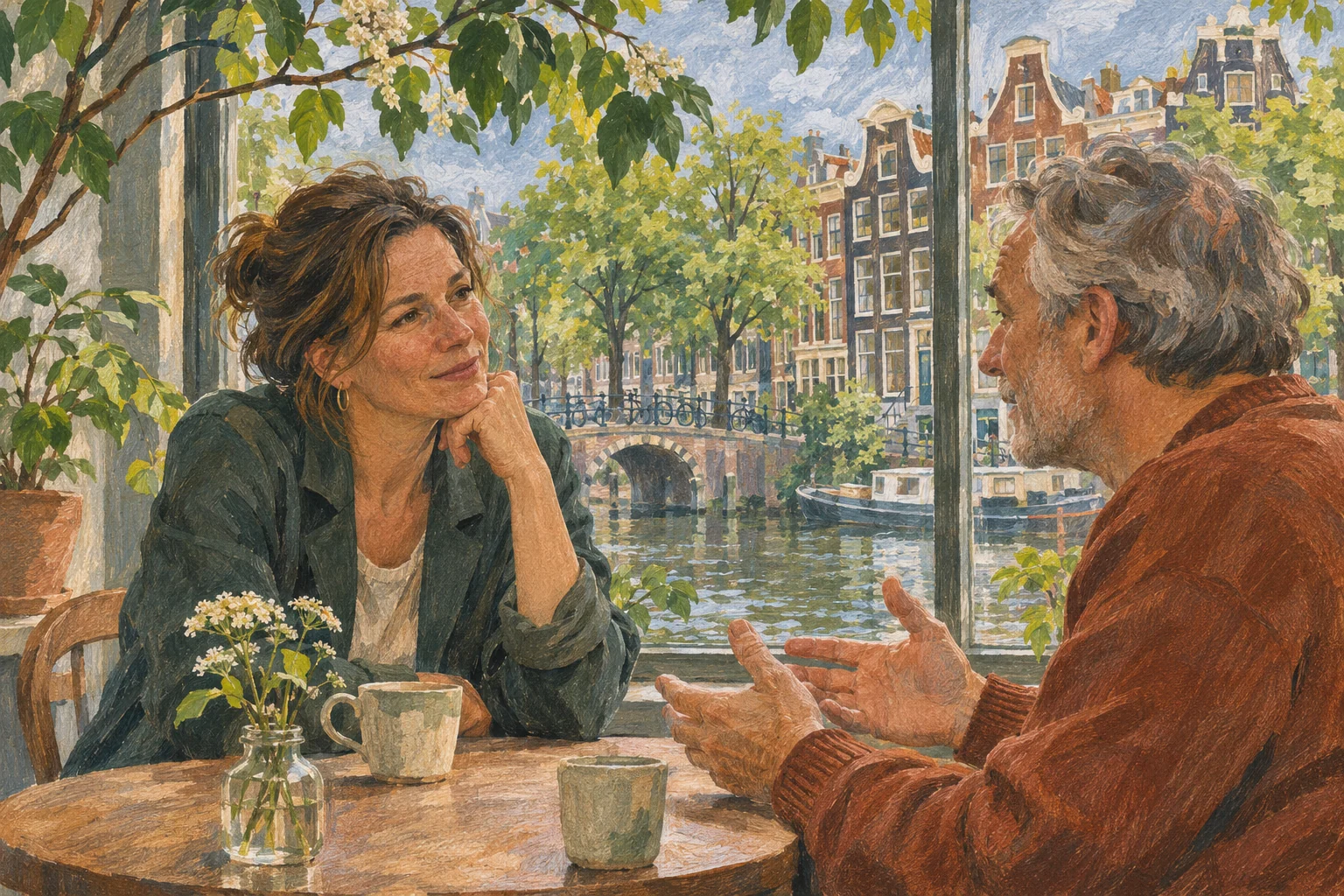
In this expression, geestelijke refers to the inner life and verzorging names the care provided.[1] The professional association describes it as support and advice about meaning and worldview.[1]
The role title means spiritual caregiver: verzorger names the person who provides care, while verzorging names the activity.[1]
The root of geestelijk appears as geistis in a tenth-century Dutch text about spirit.[21] By 1688, geest is also attested in the sense of human thought and feeling.[21]
The care words belong to the family of zorg: Old Dutch sorga meant care or concern in the tenth century.[22] A 1570 example speaks of care for both body and soul.[22]
In a Gospel book given to Egmond Abbey, Dirk and Hildegard appear kneeling before Saint Adalbert, asking him to intercede for them with Christ.[11] The image preserves a request for spiritual help in the donors’ own religious world.[11]
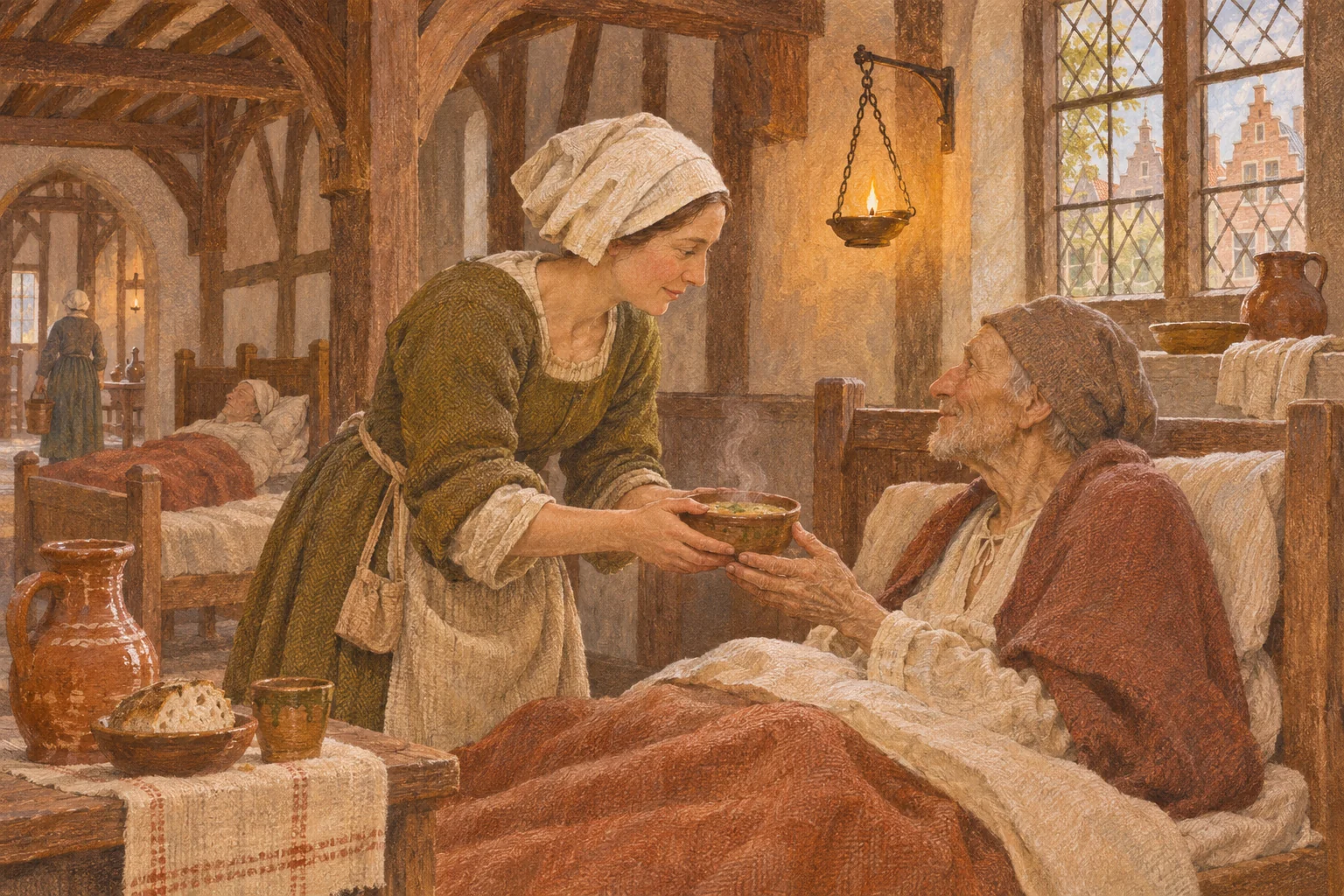
A gasthuis offered shelter to travellers and care to sick and older residents.[10] In the medieval ward, an altar shared the room with those staying there, and the house had its own priest.[10]
The Catharina Gasthuis in Gouda gained a separate chapel.[10] Its changing layout gives a local glimpse of how worship and care shared space.[10]
Four Catholic chaplains and eight Protestant field ministers served in the Dutch army, giving soldiers access to clergy from both traditions.[23]
Defence established humanist spiritual care, giving service members a humanist form of accompaniment.[24]
The distinction between formal, non-formal and informal care concerns how care is provided and the relationship in which it takes place.[12]
A spiritual caregiver works in a recognized professional role.[12]
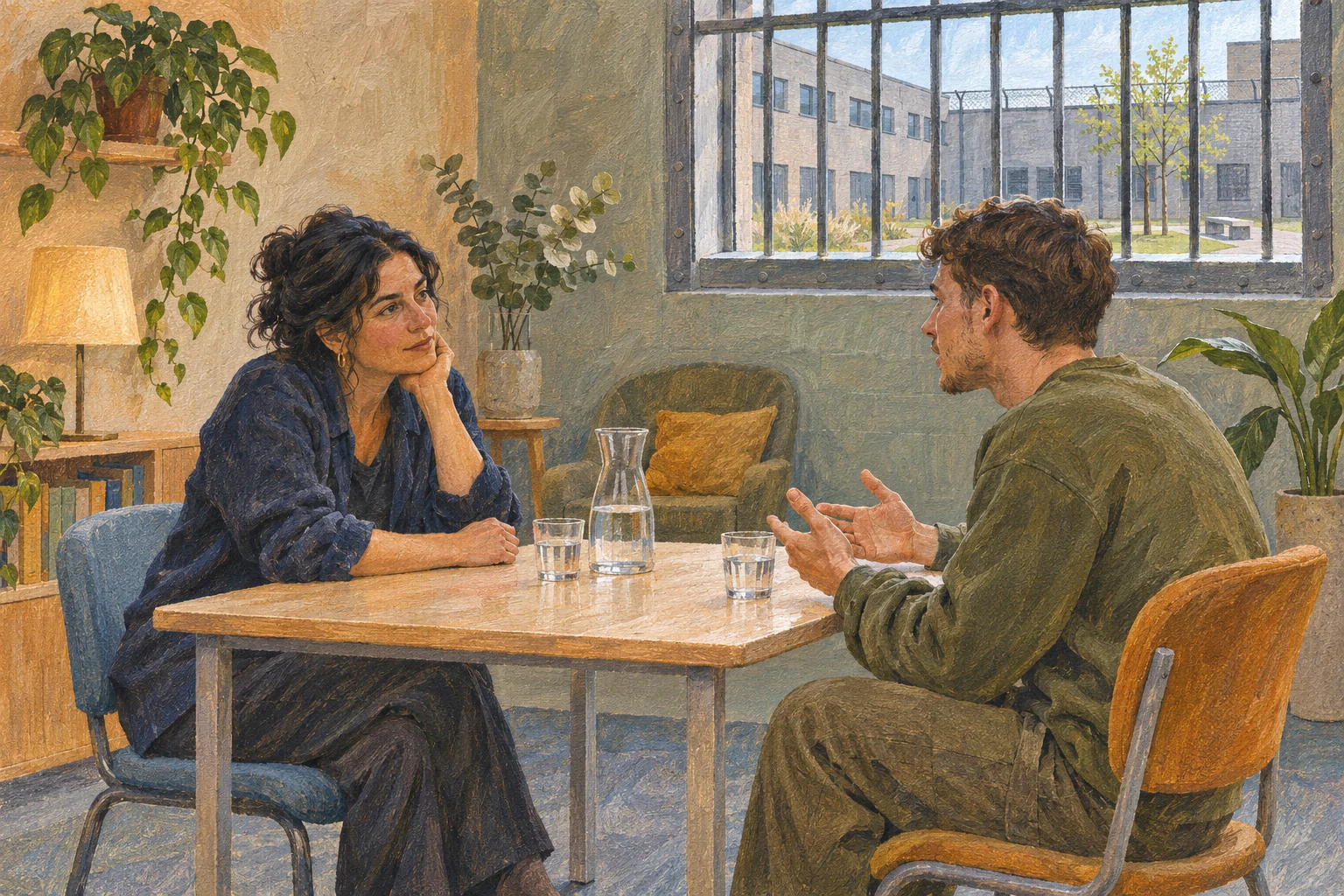
In Dutch custodial institutions, practitioners are employed by the state and endorsed by a religious or humanist body.[4]
Care can be organized by a community.[12]
The Joannes de Doper parish arranges visits for people who have lost contact with the church through illness, disability or age.[2]
Family and friends can accompany one another in grief.[12]
At Utrecht’s remembrance greenhouse, visitors can come together, share a memory or simply sit beside each other.[3]
The national service supports people in custody, including young people and people in immigration detention.[4] Its practitioners come from seven religious and humanist traditions.[4]
Dutch police list spiritual caregivers among the specialists in each unit’s occupational health team.[8] The team supports officers and advises their supervisors.[8]
Hospice Kuria in Amsterdam includes a spiritual caregiver in its multidisciplinary team.[9] This is one hospice’s staffing model.[9]
Defence spiritual care serves personnel, veterans and their families.[6] Its work includes personal conversations, group reflection and services, including during deployments.[6]
Article 3 of the Kwaliteitswet zorginstellingen required providers of care involving a stay of at least 24 hours to make spiritual care available that matched patients’ religion or worldview as closely as possible.[25]
On 1 January, article 41 of the Penitentiaire beginselenwet came into force, requiring the director to make sufficient spiritual care available that matched detained people’s convictions as closely as possible.[26][27]
The state recognized the Hindoe Raad Nederland as the endorsing body for Hindu spiritual care in the custodial service.[5]
From 1 January, article 6(a) of the Wkkgz carried forward the duty to provide access to spiritual care consistent with a client’s religion or worldview where care involves a full-day stay in an accommodation.[28][29]
Annual grants supported home consultations for palliative patients and their loved ones, and for people aged 50 or over with questions of meaning.[30]
A ministerial amendment effective on 1 July moved the expiry of the palliative terminal care and home spiritual care scheme from 1 January 2027 to 1 January 2028.[31]
Healthcare supervision
Under article 24 of the Wkkgz, inspectors supervise compliance with the Act, including the provider’s duty under article 6(a) to make spiritual care available in residential care.[28][32]
Oversight and complaints in custody
Under articles 7 and 60 of the Penitentiaire beginselenwet, the local supervisory committee oversees detention and its complaints committee can review a director’s decision affecting a detained person, including a decision about access to a spiritual caregiver under article 41.[27]
Appeals in custody
Under article 69, a detained complainant or the director can appeal a complaints committee ruling to the RSJ, which gives a second level of review for an eligible dispute about spiritual care.[27][34]
Traditions & worldviews
The Dutch Custodial Institutions Agency lists seven traditions within its spiritual-care service.[4] Its practitioners hold a mandate from a religious or humanist body.[4]
Read about Hindu care in custody
An Indigenous practice belongs with a named community, place and account. A community-specific source and guidance on depiction are still needed for this pilot.
Smeets describes two ways to organize Dutch hospital chaplaincy: a caregiver can be assigned to a ward or matched to a patient’s worldview.[17] The choice affects whether the first contact starts with the place of care or with religious or humanist affiliation.[17]
In one Dutch healthcare team, chaplains differed over how explicitly their own worldview should shape their shared professional identity.[13] Wierstra and colleagues report that discussing those differences helped the team identify common ground.[13]
The 2023 evaluation found that the home-care subsidy was increasingly used, while limited monitoring left unanswered which groups were still missing out.[30] The minister called for better information on reach and for attention to when a professional, volunteer or someone already close to the person could help.[30]
Netherlands collections
The Dutch professional association uses this term for skilled support with questions of meaning and worldview.[1] It includes guidance and advice.[1]
Literally a guest house.[10] In medieval Gouda, it sheltered travellers and cared for sick townspeople.[10] The term’s meaning changed as the institution developed into a hospital.[10]
An endorsing body.[4] In Dutch custodial care, a religious or humanist body entrusts a practitioner with a mandate to represent its tradition while working for the state.[4]
The role title means spiritual caregiver: verzorger names the person who provides care, while verzorging names the activity.[1]
In Utrecht’s Rouwen en Vieren greenhouse, people choose how to remember someone.[3] Lighting a candle or writing on a ribbon gives a visitor something tangible to do alone or with others.[3]
The Joannes de Doper parish arranges visits at home and in care institutions.[2] The encounter helps someone remain in touch with their community when visiting church becomes difficult.[2]
The military spiritual-care centre at Beukbergen hosts facilitated groups at transitions in a service career, including around a deployment.[7]
A questionnaire used to assess nursing competencies in spiritual care was tested with Dutch nursing students.[18]
Dutch researchers developed this questionnaire to study spirituality among both religious and nonreligious people.[19]
Researchers in Utrecht evaluated whether the diary’s social and spiritual items capture concerns reported by people receiving palliative care.[20]